Artificial intelligence (AI) refers to the exploration of intelligent behavior exhibited by humans, animals, and computers, in addition to the discovery and development of AI technologies. It represents one of the most challenging yet profoundly intriguing endeavors ever undertaken by humanity. AI is not merely a system; rather, it is an application that can be integrated into various systems.
AI is a vast field of study, and with time, it will grow more. That is why it is hard to classify it. But AI is divided into two types; both types have their strengths and weaknesses.
TYPES OF AI:
AI is divided into two types: the first is based on its capabilities, and the second is based on functionalities.
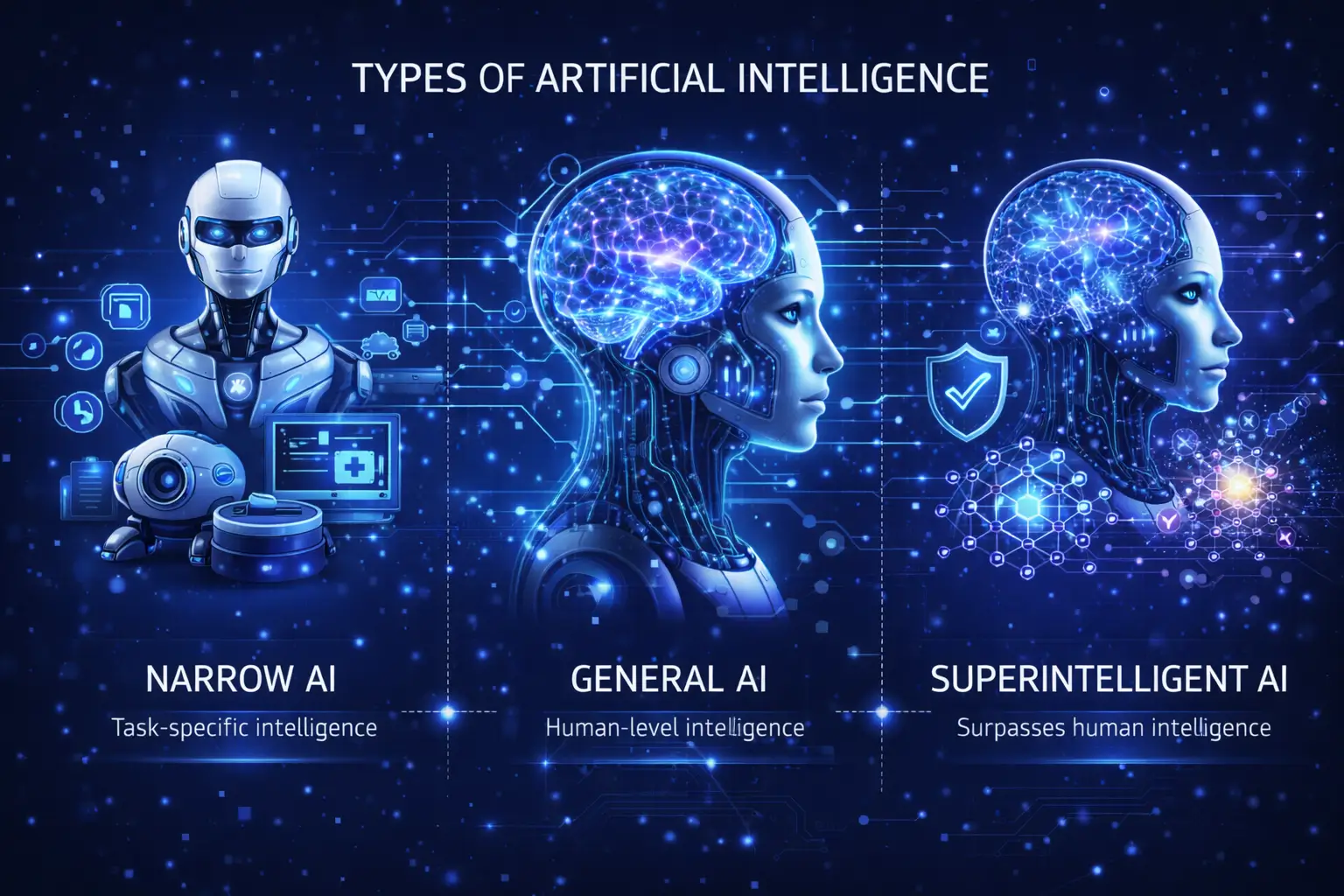
AI-based capabilities are narrowed down into three sub-fields.
- Narrow AI (Weak AI)
- Artificial General AI (Strong AI)
- Superintelligent AI (Super AI)
AI-based functionalities are narrowed down into four sub-fields.
- Reactive Machine
- Limited Memory in AI
- Theory of Mind
- Self-Awareness AI
NARROW AI:
Narrow AI cannot function outside its field or constraints since it is only programmed for a single purpose. As a result, it is often referred to as weak AI. When narrow AI is pushed past its bounds, it might fail in unexpected ways. But it is the commonest AI that is used today.
Apple Siri is a wonderful example of Narrow AI; however, it has a limited set of predefined capabilities. In narrow AI, we can also include the face and voice recognition feature, online shopping on websites, and self-driving.
ARTIFICIAL GENERAL INTELLIGENCE:
Artificial general intelligence (AGI), often referred to as strong AI, is currently a theoretical concept. AGI has the potential to apply existing knowledge and skills to tackle new tasks in different environments, thereby eliminating the need for humans to instruct the underlying models. This capability would enable AGI to perform any cognitive activity that a human can.
While AGI remains a concept at this stage, developers believe that technologies such as ChatGPT, supercomputers, and quantum hardware could serve as important initial steps toward achieving AGI.
SUPERINTELLIGENT AI:
Artificial superintelligence (ASI), sometimes known as super AI, is a true imaginative concept. It is hypothesized that if AI reaches the level of general intelligence, it will learn at such a rapid pace that its knowledge and skills will surpass those of even humans.
ASI will be the main technology for creating fully self-aware AI and other robots that work on their own. Important features of a strong AI include the ability to think, reason, solve problems, make decisions, plan, learn, and communicate independently.
SuperAI remains a speculative topic in the field of artificial intelligence. The development of such systems in the actual world remains a world-changing challenge.
REACTIVE MACHINES:
Reactive machines are those kinds of AI systems that depend on the current input or data. Reactive machines have no prior knowledge or memory to do certain tasks. These systems work on the data that is accessible to them at the given moment. Reactive AI is based on statistical information and can evaluate large volumes of data to provide surprisingly intelligent results.
IBM’s Deep Blue system and Google’s AlphaGo are other examples of a reactive machine.
LIMITED MEMORY IN AI:
Limited Memory AI is different from reactive machine AI because it can remember past events and track specific objects or situations over time. It uses information from the past and present to choose the best actions to achieve a goal.
However, limited memory AI can only remember data for a short time and does not keep a long-term record of past experiences. It can improve its performance by learning from new data.
Virtual assistants like Siri, Alexa, and ChatGPT are all examples of limited memory.
THEORY OF MIND:
This kind of AI came under the classification of general AI. The main function of the theory of mind AI would be to understand thoughts and emotions like humans. This system will make AI equal to human minds, and they can establish a human-like relationship. Because Theory of Mind AI can determine human motives and reasoning, it will tailor its interactions with humans to their own emotional needs and goals. Theory of Mind AI would also be capable of understanding and interpreting artwork and writings, something that current generative AI technologies cannot achieve.
But again, AI still needs to develop with this kind of perfection so that it can imitate human minds.
SELF-AWARENESS IN AI:
Self-aware AI is a type of advanced AI that we can only imagine for now. If it were to exist, it would understand its thoughts and feelings, as well as human emotions and ideas. It would have its own emotions, desires, and beliefs.
Emotion AI is a developing form of this advanced AI. Developers hope it will analyze speech, images, and other data to recognize and respond to human emotions. Currently, emotional AI cannot understand or respond to human feelings.
Leave a Reply