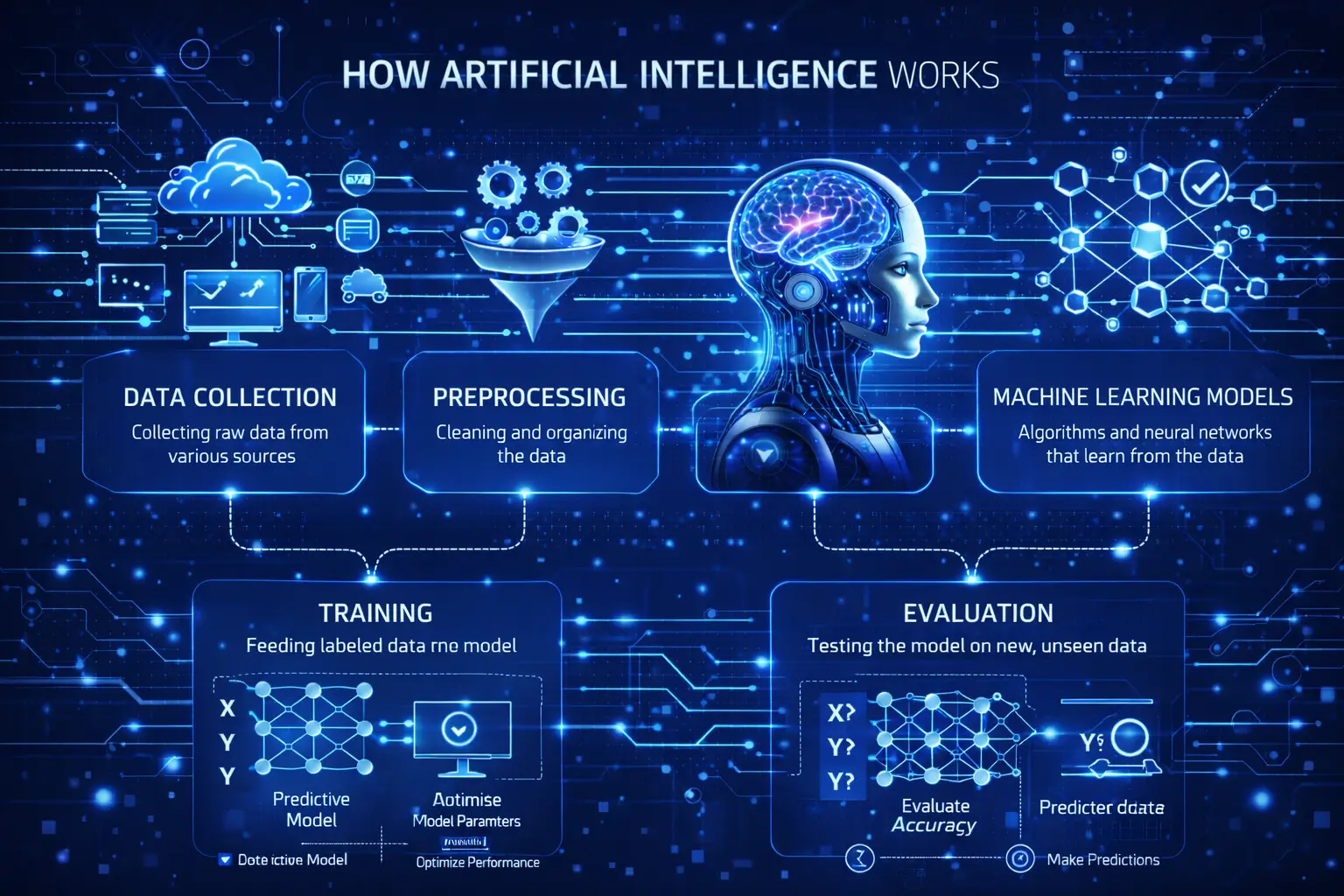
AI is a new technology that aims to imitate human intellect. It enables computers to mimic how the human brain thinks, learns, and makes decisions.
AI works by mixing large amounts of data, human oversight, and mathematical probability. Creating practical AI systems requires a multistep AI design and training approach.
HOW AI WORKS?
AI works in a step-by-step process and then generates its result.
DATA COLLECTION:
The process begins with data collection. The success of an artificial intelligence technology is determined by its first data. Engineers must carefully choose vast data sets to establish how the AI functions. Sometimes these data sets encompass many topics, such as ChatGPT. Sometimes the data is narrowly concentrated, such as healthcare information from hospitals in a small region.
PREPROCESSES DATA:
Before processing data, it first preprocesses the data through cleaning, evaluation, correction, and standardization. The data is explained or classified as well for better results. Reviewing and improving the data before using it in an AI model can lower the chances of the AI making mistakes and providing incorrect responses.
TYPES OF MODELS:
Once the data is ready, AI engineers need to choose an AI model to train. There are four main types of AI models.
- Supervised learning models: These models depend on data that humans have labeled. Engineers must clearly define each data point so the AI can learn and make predictions.
- Unsupervised learning models: These models use data that is not labeled. The AI can find patterns in the data, which helps it predict what happens next.
- Reinforcement learning models: These models let the AI interact with its surroundings. The AI collects data about how well its actions perform, which helps improve future performance.
- Deep learning models: These models use a neural network with multiple layers of neurons. As data moves through each layer, the AI makes calculations, finds relationships, and forms connections.
TRAINING DATA:
After choosing a model, training can start. Usually, we divide the data into two parts: one for training and one for testing. Developers input the training data into the model. As training continues, the model calculates and finds patterns that help it make future predictions. The time it takes to train a model depends on the type of model and the amount of data used.
EVALUATING DATA:
After processing the first training data, the AI model is ready to be tested. Engineers will assess metrics such as accuracy, which demonstrates correct predictions; precision, which evaluates the accuracy of positive forecasts; and recall, which reveals how effectively the model detects all relevant situations. By studying these data, engineers may better understand the model’s strengths and limitations and enhance its performance.
ISSUES IN MODEL TESTING:
Sometimes, the AI model’s testing results are not accurate. The developers may notice three main issues:
- If the given data is not accurate or poorly produced, it affects the results.
- There are patterns in data that help AI to work efficiently, but when these are too simple, the results can be manipulated.
- Being biased is not good in any way, and for training data, one-sided data is also not beneficial for AI.
If developers find any of these shortcomings, they must improve the model. This may be performed by modifying the neural layers and nodes in a deep learning model, updating the AI algorithms, and standardizing the data.
APPLICATION:
When the developers confirmed the model’s performance, they approved it for the use of common people. For using the models, developers either add them to their current tools or develop applications that utilize the models.
AI LEARNING CONTINUES:
AI models require constant training; they are not trained once and then forgotten. Engineers work constantly to upgrade these AI models with new data. There are several methods for doing this training. One approach is to enhance the original AI model by incorporating additional data. Another approach is to get input from individuals based on the model’s replies. The AI training team uses this feedback to improve the model.
AI has a vast circle of technologies, which help it work more proficiently. A few are these:
- Computer vision uses pattern identification along with advanced learning to analyze photos and movies, enabling robots to figure out their environment instantly.
- Natural Language Processing (NLP): Allows systems to evaluate and produce human language, making natural communication easier for task completion.
- Graphics Processing Units (GPUs): Give the analytical ability required to train neural networks on huge datasets.
- The Internet of Things (IoT) creates huge amounts of data that remain unanalyzed, which AI may help to manage and efficiently use.
- Advanced Algorithms: Combine to analyze data faster, identifying rare events and optimizing complex scenarios.
- APIs: Allow integration of AI capabilities into existing software, enhancing features like image recognition and data insights.
AI aims to create software that simulates human-like reasoning and provides decision support, but it is not a replacement for humans.
Leave a Reply