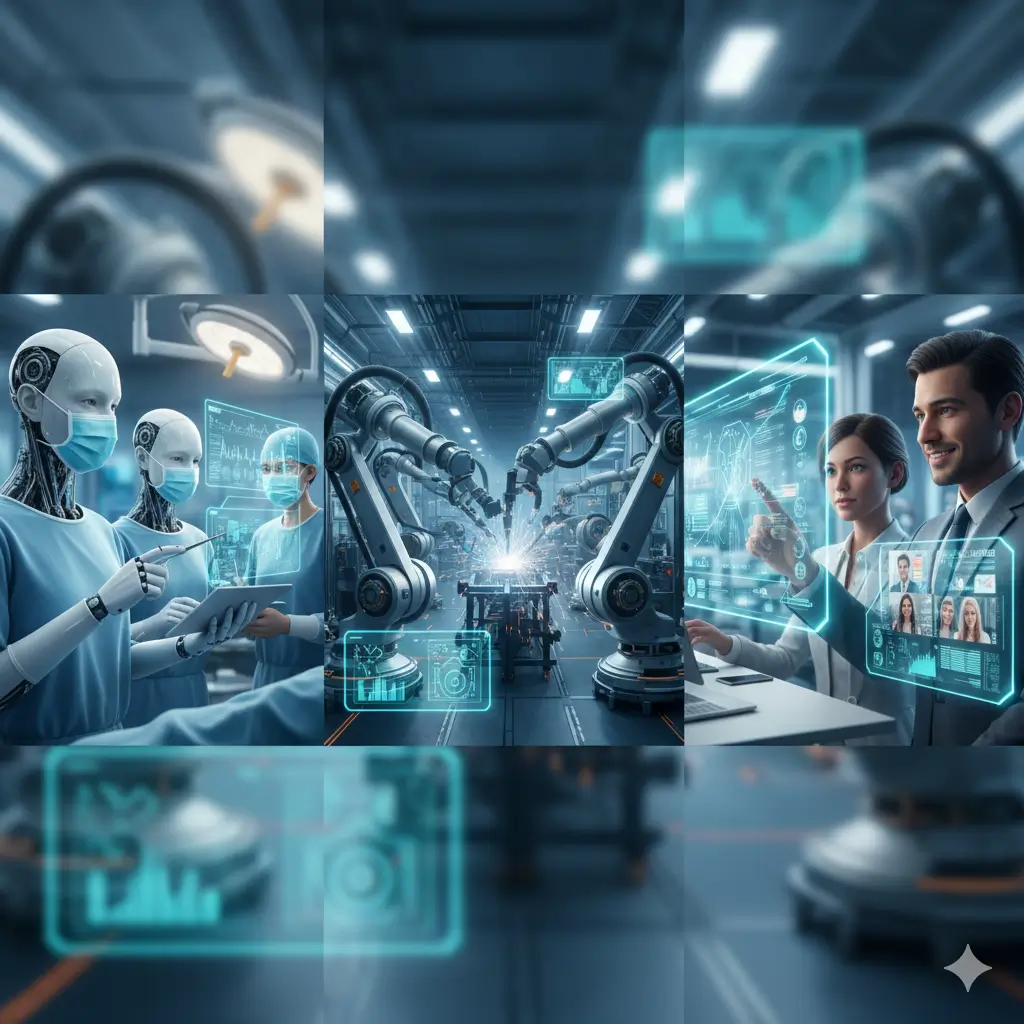
BENEFITS OF AI:
A machine could not produce ice cream or fly over the Pacific until recently. These are now commonplace elements of everyday life thanks to advances in computer science and mechanical engineering that enable robots to do activities formerly performed by people.
Emerging technologies have pushed machine capabilities even further. Artificial intelligence (AI) is a field of study that has produced computer software that mimics human cognitive processes. Machine learning enables AI systems to do prose writing, musical creation, data analysis, computer programming, and medical diagnosis. In many circumstances, they can complete such jobs rapidly and without human interaction.
Artificial intelligence presents multiple advantages across numerous sectors, and its benefits are expected to increase over time, significantly enhancing its value to humanity.
- Automation
- Human errors
- increase in business
- Enhancing Healthcare
- Better customer experience
- New Research
- Smart decision
.
AUTOMATION:
Reducing the time and effort required to finish a task is the most astounding advantage of AI. Individuals used paperwork to enter data prior to the 2000s, which took a lot of time and human labor.
These days, a lot of businesses are using software robots to carry out these tasks automatically to boost productivity and efficiency and stay competitive. One of AI’s most well-known advantages is automation, which is applied extensively in a variety of industries, including manufacturing and transportation.
Automation is simply the process by which a machine performs basic, repeatable tasks in response to human-provided instructions. Automation is less labor-intensive than its traditional equivalent, even if it still requires some human input.
HUMAN ERRORS:
The decrease in the possibility of human error is a major benefit of automating routine commercial processes with AI solutions. Data entry and processing are handled by robotic process automation (RPA) tools, which improve digital systems’ efficiency and reduce the possibility of errors during data processing. For companies that can’t afford even the slightest errors, this is helpful.
AI, for instance, can evaluate medical information and help physicians diagnose patients. Furthermore, AI is used by self-driving cars to make decisions. AI software will remain essential to our daily lives as long as it is thought to be less error-prone than human labor.
INCREASED IN BUSINESS:
An increase in business means that AI helps companies 24/7 with reliability. Because AI is a system that is trained to perform daily tasks without getting bored or tired, with productive results each day. When AI is doing data-related jobs, the employees can concentrate on more complex jobs in which human assistance is required.
Data gathering and analysis, inventory management, customer service, and data entry are routine tasks for the majority of businesses. AI saves time and effort and can do it flawlessly. By automating these duties, businesses can eliminate time-consuming processes and redirect resources to more valuable endeavors.
ENHANCING HEALTHCARE:
There are numerous ways in which AI-based solutions could be extremely beneficial in the healthcare industry.
It is used for administrative tasks like data entry and test analysis, as well as much more complicated procedures. AI-powered robots may even do surgery in the future, minimizing human error and even saving lives. For example, remote patient monitoring technology enables medical professionals to make clinical diagnoses and recommend treatments promptly without the patient having to physically visit the hospital. AI can also be used to monitor the progression of infectious diseases and even predict their future effects.
BETTER CUSTOMER EXPERIENCE:
From long wait times to unsolved tickets, poor customer service is a prevalent complaint worldwide, producing continuous annoyance, inefficiency, and strain.
However, when customer support personnel are inundated with emails and phone calls, it’s difficult to criticize them for providing bad service.
There are numerous ways that AI has improved customer service in recent years, particularly with the development of smart chatbots. These are proactive, not reactive (like conventional bots), and can accept user inputs and algorithmically find solutions without much human intervention.
NEW RESEARCH:
AI and machine learning technology can significantly improve data analysis efficiency. It can help to develop predictive models and algorithms for data processing and understanding the potential outcomes of various trends and events. Furthermore, AI’s sophisticated computing skills can accelerate the processing and analysis of data for research and development that would otherwise take too long for humans to analyze and understand.
As a result, significant inferences are drawn, trends are identified, and scientists are equipped with the information they require to produce breakthroughs and discoveries.
SMART DECISION:
There’s a reason why organizations are putting more emphasis on emotional intelligence than ever before: it reduces bias and subjectivity in decision-making.
Artificial intelligence can analyze patterns, build data consistency, provide forecasts, and detect anomalies, allowing it to make wiser, more unbiased data-driven judgments. It’s no surprise that 86% of executives are currently adopting AI in their firms.
AI helps in two ways. The first step is to remove these automated tasks so they can find qualified prospects with more time and space. The second benefit comes from the choosing process itself.
AI can assess CV scores in seconds without prejudice, resulting in a more robust selection process, which may lead to higher matching accuracy and longer employee retention.
Leave a Reply