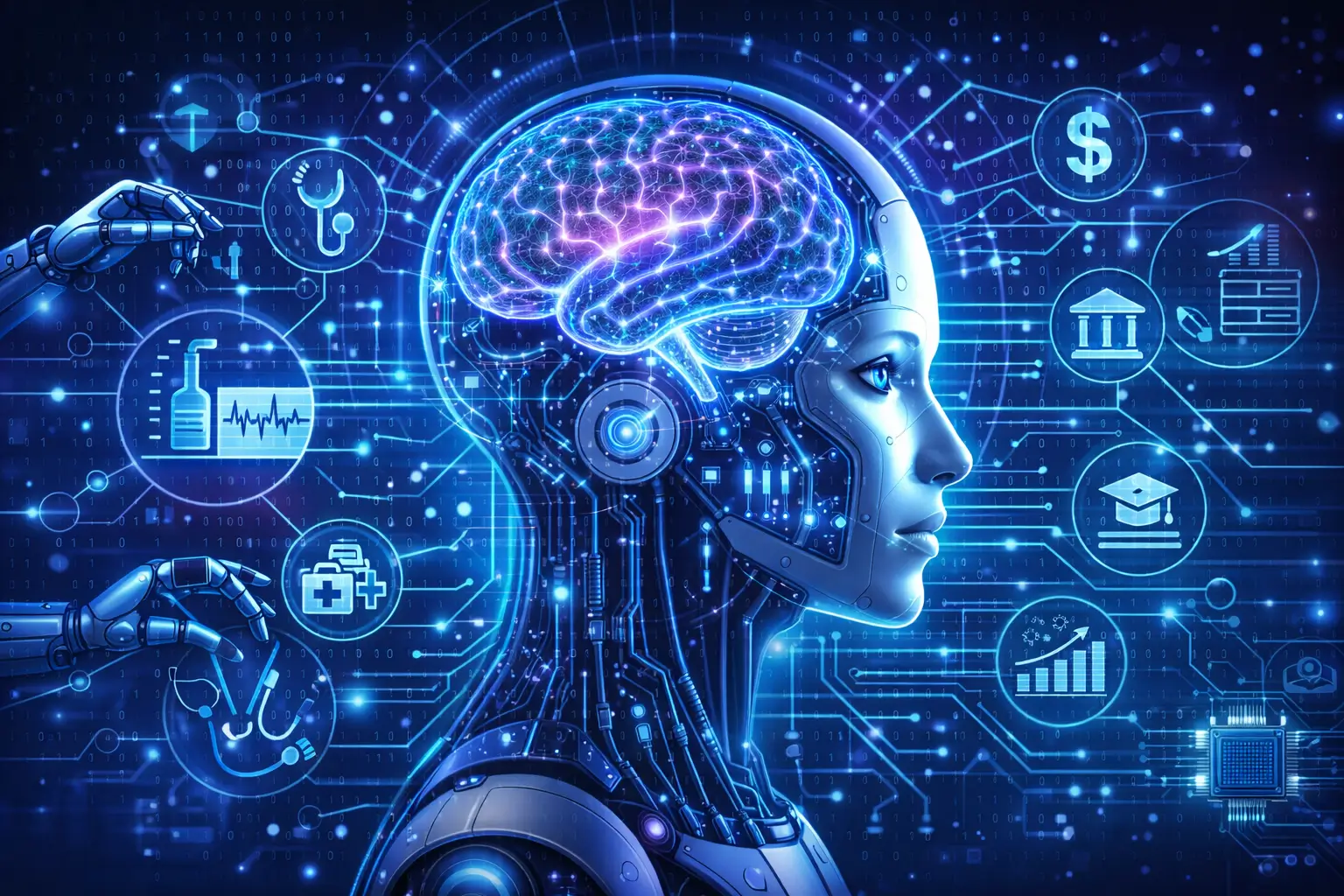
Artificial intelligence (AI) is one of the most significant technological advances in the modern world. This intelligence system allows computers and other electronic devices to do jobs more effectively, which benefits humanity.
Computers were originally developed primarily to conduct mathematical computations. However, significant developments have occurred over time to improve their effectiveness. As we all know, large-scale advancements continue to boost the capacity of our digital devices. Despite these gains, computers struggle to match human intelligence, particularly in activities requiring vast everyday knowledge across several disciplines.
Nonetheless, technological advancements have had a huge influence on the world. AI is presently used in a variety of applications throughout the world, including medical diagnosis and procedures, chatbots, search engines, voice and handwriting recognition, and document and video creation.
ARTIFICIAL INTELLIGENCE AND ITS USE:
AI can aid humans with learning, problem-solving, thinking, perception, and language comprehension. With time, new advancements in every industry have increased the relevance and use of AI. It aids in identifying the hazards that any project may create and recommends safeguards along with the outcomes. AI is useful in both educational and professional contexts.
AI transforms perception by using improved sensors to gather data from the surroundings. It then processes and interprets this data, allowing robots to “understand” the environment in ways similar to human sensory experience. This extraordinary capability enables AI to detect things, navigate complicated environments, and make strategic decisions based on real-time sensory information.
TYPES OF ARTIFICIAL INTELLIGENCE:
AI has a wide variety, but for clarity, there are three: narrow or weak AI, general or strong AI, and super-intelligent AI.
- Narrow AI is used to do simple or routine activities such as facial identification, internet surfing, and driving a car. Narrow AI can also play complicated games like chess and perform other tasks that fall within this category. They function within a predetermined range or set of situations.
- General or strong AI: This type of AI has human-like thinking abilities. It can handle new and unfamiliar tasks on its own. This strong AI can understand, learn, and use its intelligence to solve problems without needing help from humans.
- Super-intelligent AI: This sort of artificial intelligence is connected with superhuman abilities. This type of intelligence has the potential to boost creativity and technological advancement in domains where humans fail. While interesting, the concept of superintelligence remains mostly speculative and has yet to be realized in today’s modern setting.
ARTIFICIAL INTELLIGENCE BENEFITS
- AI drastically reduces the time required to complete a wide range of tasks, allowing individuals and organizations to work more effectively. By automating routine tasks, AI enables successful multitasking while lowering the need for vast human resources and improving current ones.
- AI makes it easier to carry out difficult tasks that used to take a lot of time and knowledge, all while keeping operating expenses low. This creates chances for creativity and innovation since corporations may transfer their resources to more strategic projects.
- AI systems are meant to work around the clock without interruption, delivering optimal productivity and durability. This continual availability provides companies with the ability to adapt to demands and difficulties in real-time, giving them a competitive advantage in fast-paced contexts.
- Artificial intelligence has enormous commercial potential, with applications in a wide range of industries, including healthcare, finance, manufacturing, and education. Its adaptability enables organizations to use AI for a variety of goals, including automating regular jobs, improving customer relations, and increasing operational efficiencies.
- AI dramatically improves decision-making processes by offering enhanced analytical tools that not only speed up data processing but also provide deeper insights. This skill helps firms to make more informed decisions faster and with higher precision, resulting in better results and strategic benefits in a competitive environment.
ARTIFICIAL INTELLIGENCE DRAWBACKS:
- AI companies do not share the potential danger of their AI tools and how they can impact the common man. That makes it a lot harder for lawmakers to regulate the law efficiently for AI development efficiently.
- AI is a huge risk for people related to marketing, manufacturing, healthcare, and even teaching fields due to its adoption by companies and organizations for efficient working.
- Most people may not be aware of the potential dangers associated with AI self-awareness. As AI technology continues to advance, particularly with chatbots and virtual assistants, there’s a growing concern about their ability to communicate with humans in ways that can manipulate thoughts and behaviors.
- Online media and news have become more confusing due to AI-generated images, videos, voice changers, and fakes. These technologies allow people to create realistic photos, videos, and audio clips or to swap one person’s image with another in a picture or video.
ARTIFICIAL INTELLIGENCE AND ITS FUTURE
Artificial intelligence (AI) has a promising future, but it also confronts significant challenges. AI is expected to become more prevalent as technology advances, revolutionizing industries such as healthcare, finance, and transportation. The labor market will shift as a result of AI-driven automation, forcing the creation of new jobs and skills.
AI is readily extensible, versatile, and applicable to a variety of business processes. When we recall that AI is only a computer program, we may be able to better appreciate its potential applications. AI is being used extensively due to its capacity to bring intelligence to previously unintelligent occupations.
As these technologies get better, the risk of misuse increases. People need to learn how to find reliable information. We need to be aware of the impact of AI in shaping how we see things. With images and sounds that can easily be changed, everyone, including tech companies and policymakers, must work together to promote trustworthy news sources.